Why upgrade a manual filling line to automatic? The answer is not simply speed. Manual filling can become difficult to manage when orders grow, product changes become frequent, or operators spend hours repeating the same motions. A small spill near the filler, inconsistent fill levels, and handwritten production counts can reveal where the process is under strain. Still, automation is not a cure-all. A poorly planned system can make small problems harder to spot.
For teams researching how to upgrade a manual filling line to automatic, the first step is to document the line as it operates today. Record container sizes, product viscosity, fill accuracy, changeover time, cleaning needs, and output by shift. Then identify which tasks create delays: container handling, dosing, capping, or inspection. Quality-management expert W. Edwards Deming is widely associated with the reminder, “A bad system will beat a good person every time.” That principle matters here: improve the process before automating it. Start with equipment that matches real production needs, and consider a staged upgrade rather than replacing everything at once. A semi-automatic filler or a compact conveyor may be a sensible bridge for some facilities. It may not be the right fit for yours. Compare supplier specifications with product trials, and ask how adjustments, maintenance, and operator training will work on the actual floor. The first plan may be wrong. That is useful to discover before installation, not after.
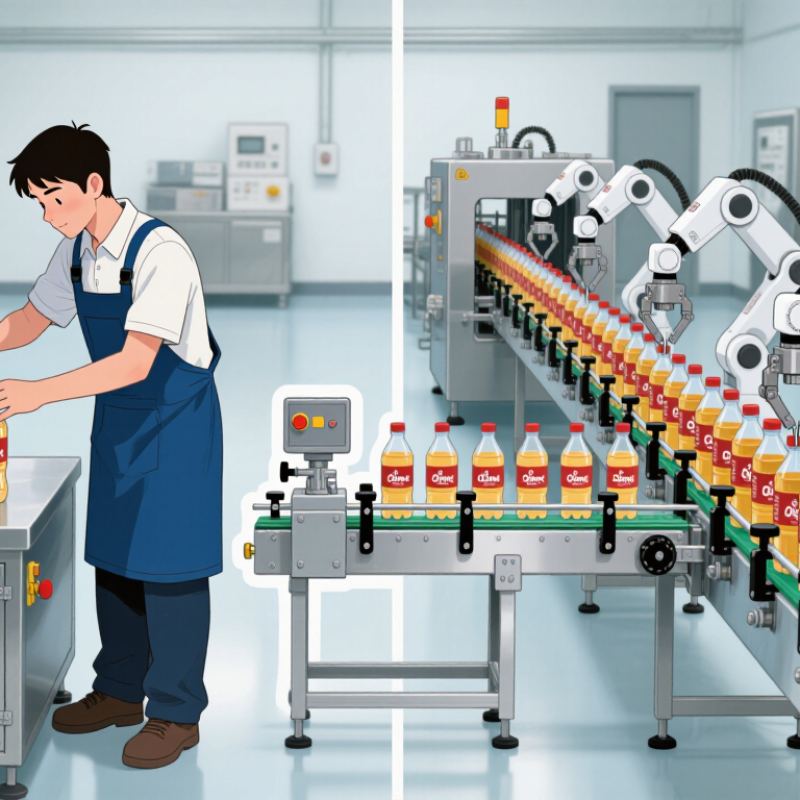
A manual filling line relies on people to position containers, start or control each fill, and move products to the next station. The equipment may include a hand-operated pump or a simple dosing head. In practice, one worker watches the liquid level while another wipes drips or replaces caps. The pace depends on coordination, training, and product behavior. Thick liquids, foam, and small bottles can slow the work. That is the trade-off. A manual setup can be flexible and inexpensive, but output and fill consistency may vary across shifts. It is not automatically inefficient; a short run of changing products may suit manual handling better.
Labor demands also deserve attention. The U.S. Bureau of Labor Statistics reported 2.8 recordable injury and illness cases per 100 full-time workers in manufacturing in 2023, compared with 2.4 across private industry. These figures cover manufacturing broadly, not filling lines specifically. They do, however, make repeated lifting, reaching, and hand movements worth reviewing rather than dismissing. Manual operation can also make production records harder to standardize, especially when staff estimate fill levels by eye. That assumption needs testing with actual weigh checks.
Tips: Time a full shift, not just a fast sample. Record filled units, rework, spills, and operator breaks. A simple log may reveal whether the real bottleneck is filling, container handling, or changeovers.
A manual filling line relies heavily on operators to position containers, dispense product, and maintain a consistent fill. Automation can reduce routine hands-on work and improve process repeatability, but results depend on the product, equipment, and setup.
Illustrative relative ratings on a 1–5 scale, not measured industry benchmarks. Higher scores indicate more of the stated characteristic; actual performance varies by application.
A manual filling line may be ready for automation when demand regularly exceeds what the crew can produce at a steady pace. Watch the line during a full shift, not just a short trial. If operators repeatedly rush near the end of an order, or filled containers queue at the capping station, the bottleneck may be more than a busy afternoon. That is a warning.
Staffing pressure is another signal. Frequent training, overtime, or missed breaks can make output unpredictable and increase handling errors. So can repeated variation in fill levels, drips around nozzles, or inconsistent cap placement. Track these issues by shift and product type; a single bad run does not prove the whole line needs replacing. Changeovers matter, too. If several small batches require lengthy cleaning and setup, automation may not help unless the equipment suits those product changes.
Measure actual throughput, downtime, scrap, and labor hours before choosing an upgrade. Compare the numbers with the output the business genuinely needs, including seasonal peaks. It is easy to mistake a staffing problem for a machine problem. And forecasts can be wrong. A limited pilot or process review can show whether automatic filling would relieve a real constraint, or simply move the queue to labeling and packing.
Use these operational indicators as screening criteria, not universal limits. Actual upgrade decisions depend on product properties, container design, required accuracy, staffing, and the cost of errors.
| Production dimension | Signals from a manual line | Practical indicator to track | Why automation may help | Before upgrading, verify |
|---|---|---|---|---|
| Required output | Orders regularly exceed what the available operators can fill during scheduled shifts. | Good containers filled per hour, measured across a representative shift and product range. | A powered filler can sustain a more consistent cycle and reduce dependence on repetitive hand operation. | Compare the required rate with the complete line rate, including container handling, capping, labeling, and changeovers. |
| Fill accuracy and giveaway | Operators frequently adjust fill levels, and container weights or volumes vary between runs. | Record a sample of fill weights or volumes; track average fill, variation, and out-of-spec containers. | Controlled dosing can improve repeatability and help limit overfilling, subject to correct setup and calibration. | Confirm the required tolerance, product behavior, measurement method, and calibration routine. |
| Labor availability and ergonomics | Filling depends on repeated manual dispensing, and staffing gaps or fatigue affect output. | Operator time spent filling, staffing per shift, overtime, and reported repetitive-motion strain. | Automation can reduce repetitive dispensing tasks and let staff focus on replenishment, inspection, and exception handling. | Include operator training, maintenance work, line tending, and any new changeover tasks in labor estimates. |
| Product range and viscosity | Different liquids require frequent manual adjustments, or slow-flowing and foaming products are difficult to fill consistently. | List products by viscosity, foaming tendency, particulates, temperature, and required fill volume. | Suitable pump, nozzle, and control options can provide a more repeatable process for defined product families. | Run product trials: one filler design may not suit every viscosity, particle size, or foaming characteristic. |
| Changeovers and downtime | Frequent format or product changes interrupt production, and setup results vary by operator. | Measure changeover time from the last good container of one run to the first accepted container of the next. | Repeatable settings and documented procedures can make setup more consistent. | Check change parts, cleaning requirements, recipe management, and compatibility with the existing line layout. |
| Quality records and traceability | Fill checks are recorded manually, are incomplete, or are difficult to link to a batch or production time. | Review record completeness, check frequency, deviations, and time required to retrieve batch data. | Depending on the equipment, digital controls may support more structured process settings and production records. | Confirm what data the system actually captures, how it is stored, and whether it meets applicable site and regulatory requirements. |
| Spills, cleaning, and product loss | Manual pouring or nozzle handling causes regular drips, spills, product residue, or extended cleanup. | Track spill events, rejected containers, cleanup time, and product discarded during filling. | Appropriate nozzles and controlled dispensing may reduce mess and improve process consistency. | Assess drainage, clean-in-place or clean-out-of-place needs, material compatibility, and sanitation procedures. |
| Business case and capacity planning | Rising labor, overtime, missed orders, or filling losses persist despite process improvements. | Estimate total cost per accepted container and compare it with equipment, integration, training, maintenance, and operating costs. | A measured comparison helps determine whether automation can address the actual production constraint. | Use realistic utilization and include installation, utilities, spare parts, downtime, financing, and the full line bottleneck. |
Decision rule: Consider an upgrade when measured production, quality, labor, or safety problems are persistent and a tested automated solution addresses the specific constraint with a justifiable total cost.
An automatic filling line moves containers through a coordinated sequence, from infeed to final inspection. A conveyor spaces bottles or jars, while guides keep them upright beneath the filling station. Sensors detect each container and signal the nozzles to dispense a set volume. On a well-adjusted line, the nozzles lower close to the opening, helping limit splashes and product loss. Small changes in viscosity or temperature can still affect filling accuracy.
After filling, containers move to capping or sealing. A cap feeder places closures, and a tightening head applies controlled torque. Depending on the product and package, the next station may check fill level, cap presence, or seal condition. Out-of-range containers can be diverted for review rather than mixed with acceptable units. The line also needs routine checks: operators verify settings, inspect contact parts, and clean equipment between runs. Automation reduces repetitive handling, but it does not remove the need for judgment.
Tips: Test the line with the actual container and product before production. Watch for foam, drips, and uneven caps. Record adjustments. A rushed setup can create problems that only appear after several minutes of running.
Manual filling lines depend heavily on each operator’s pace and technique. An automatic filler can deliver repeatable doses and maintain a steadier rhythm across a shift. That can increase output, especially when operators spend less time handling containers and correcting uneven fills. Fewer handoffs help. Small gains add up. The first setup may feel slower, though, while staff learn the controls and the team checks the settings.
Accuracy improves when the machine is calibrated for the product’s flow and container size. Viscous liquids may need different speeds or nozzle adjustments than thin liquids. Check fill weights at regular intervals, and record results so drift is easier to spot. Automation also reduces repetitive lifting and direct contact with moving containers. Less strain helps. Guards, clear walkways, and practical training still matter; a machine does not remove every workplace risk.
Tips: Run a short trial with real containers before full production. Compare fill weights, watch for drips, and confirm workers can reach stop controls safely. Recheck settings after product or container changes.
Before choosing an automatic filler, document what the manual line actually handles each shift. Record container sizes, fill volumes, product viscosity, and how often recipes change. A thin liquid may run cleanly, while a foaming product can leave uneven levels at the same speed. Measure rejects, spills, and pauses—not just bottles per hour. Small details matter. Check whether the target fill tolerance is realistic across different containers and production runs.
Assess whether the machine can connect with existing conveyors, cappers, and labelers. Check floor space, power, compressed air, and access for cleaning and maintenance. If operators must lift heavy containers or reach around guards, the layout deserves another look. Estimate changeover and washdown time using the actual products and containers. Test it first. A production trial can reveal dripping, splashback, or inconsistent fills before installation. Compare measured output and labor savings with equipment, training, maintenance, and downtime costs. Automation can reduce repetitive work, but it does not remove the need for skilled checks. Leave room for adjustments; real lines rarely behave exactly like a spreadsheet.
It can maintain steadier filling speeds across a shift. Operators may spend less time handling containers and fixing uneven fills. Small gains add up.
No. Initial setup and staff training can slow the line. Real production may also behave differently than a spreadsheet predicts.
Calibration should match the product’s flow and container size. Thick liquids may need slower speeds or adjusted nozzles. Check fill weights regularly.
Record fill weights at regular intervals. Compare the results to find drift. A small change can be easy to miss.
No. It can reduce repetitive lifting and contact with moving containers, but guards and clear walkways still matter. Workers need practical training.
Record container sizes, fill volumes, product viscosity, and recipe changes. Track rejects, spills, and pauses—not just bottles per hour.
Use real containers and products. Compare fill weights, watch for drips or splashback, and make sure workers can reach stop controls safely.
Compare equipment, training, maintenance, and downtime costs with measured output and labor savings. Include cleaning, changeovers, and layout adjustments. Estimates may be imperfect.
A manual filling line relies on operators to position containers, dispense product, check fill levels, and move finished units through the process. While this approach can suit small batches and changing production needs, it may become difficult to maintain consistent output as volumes grow. Frequent handling, repetitive tasks, variable filling accuracy, and dependence on operator availability can signal that a different setup is worth considering.
An automatic filling line coordinates container feeding, filling, and product transfer with less manual intervention. Automation can increase throughput, improve fill consistency, reduce repetitive handling, and support a safer, more organized workspace. Before deciding how to upgrade a manual filling line to automatic, assess production volume, product characteristics, container types, available space, cleaning requirements, staffing, and budget. A careful review helps identify the right level of automation, plan a practical transition, and ensure the new process fits both current operations and expected future demand.

Collins Machine