Nitrogen packaging looks simple: remove oxygen, add nitrogen, and seal the package. In practice, the process depends on gas flow, product geometry, sealing speed, and residual oxygen. So, how does gas flushing work in nitrogen packaging? A measured nitrogen stream enters the package and pushes oxygen outward before the seal closes. The result is a lower-oxygen atmosphere around snacks, coffee, nuts, and other oxidation-sensitive products.
The Packaging Machinery Manufacturers Institute (PMMI) identifies food protection, shelf-life extension, and packaging efficiency as continuing industry priorities. Smithers also reports that flexible packaging growth increasingly depends on better barrier performance and product preservation. These findings matter because nitrogen alone cannot repair a weak film or a leaking seal. Small defects can let oxygen return, even after a carefully controlled flush.
Food-packaging researcher Dr. Richard W. Hartel states, “Packaging is an integral part of the food system.” That principle explains why nitrogen flushing requires more than a gas supply. Operators must verify flow rate, flush time, seal temperature, headspace volume, and residual oxygen levels. A package may look full and fresh while its internal atmosphere remains poorly controlled. The process is not magic. It is measured engineering.
This guide explains common flushing methods, equipment settings, testing practices, and practical limitations. It also examines why nitrogen improves protection without guaranteeing unlimited shelf life. Real production lines are imperfect. Product dust, irregular filling, and changing line speeds can reduce consistency. That is where careful monitoring becomes more valuable than attractive claims.
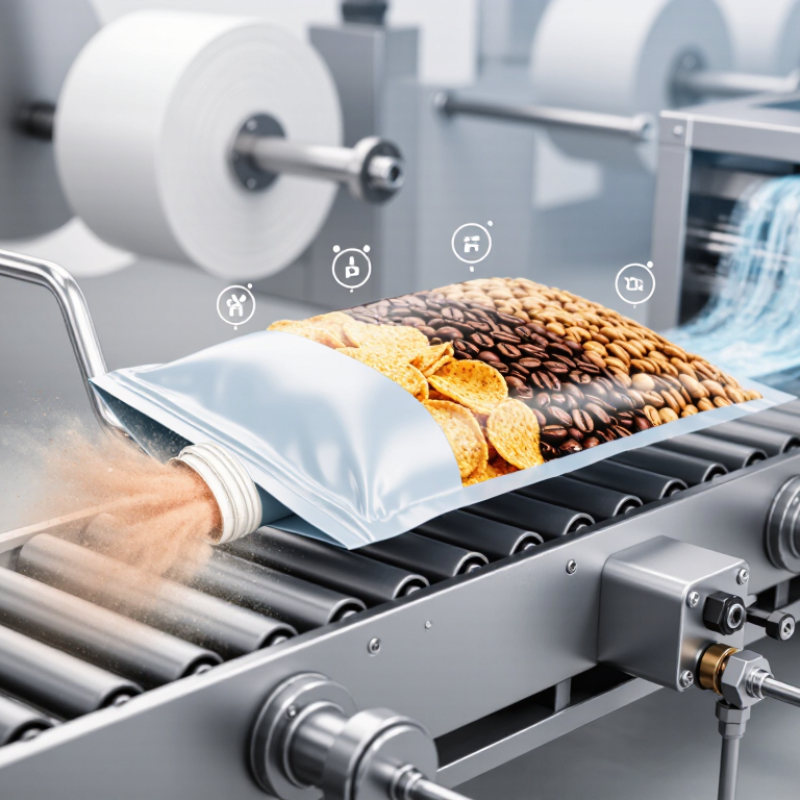
China Top Nitrogen Packaging: How Does Gas Flushing Work?
Nitrogen packaging uses a controlled gas stream to replace oxygen inside a package. During filling, nitrogen enters the pouch, tray, can, or bottle before sealing. The gas pushes out much of the oxygen and reduces moisture exposure. This helps protect coffee, snacks, nuts, powdered foods, and other oxidation-sensitive products. Nitrogen with 99.9% purity is widely selected because it offers a clean, stable packaging atmosphere. However, purity alone does not guarantee good protection. Seal quality, filling speed, product temperature, and oxygen levels after sealing also matter.
Common package types include flexible pouches, vacuum-style bags, rigid trays, metal cans, and plastic containers. Pouches are practical for lightweight goods and high-volume production. Trays provide stronger product presentation and stacking support. Cans and rigid containers offer better resistance against crushing. In production checks, operators should measure residual oxygen instead of trusting the gas specification alone. A small sealing gap can defeat a carefully controlled flush. This is easy to overlook.
Tips: Use food-grade nitrogen and verify its certificate. Check seals with routine leak testing. Adjust flushing time for each package size. Keep filling equipment clean and calibrated. A 99.9% reading is useful, but real package performance deserves closer review.
| Data Dimension | Typical Specification or Value | How It Works or What It Means | Practical Notes |
|---|---|---|---|
| Main gas | Nitrogen (N₂) | An inert gas used to displace oxygen and reduce oxidation inside a package or process vessel. | Nitrogen is not a disinfectant; it mainly changes the package atmosphere. |
| Common industrial purity | 99.9% N₂, with approximately 0.1% remaining gases | Suitable for many general industrial applications, including inerting, blanketing, and some packaging operations. | The required purity depends on the product, oxygen limit, moisture limit, and applicable regulations. |
| Higher-purity grades | 99.99% to 99.999% N₂ | Provides lower residual oxygen and fewer impurities for sensitive food, electronics, laboratory, and specialty manufacturing uses. | A higher gas purity does not automatically guarantee the same oxygen level in the final package. |
| Gas flushing principle | Replace part or most of the original package atmosphere with nitrogen | Nitrogen enters through a nozzle while air exits through an opening before the package is sealed. | The final oxygen concentration depends on flow rate, flushing time, package geometry, and sealing speed. |
| Typical flushing sequence | Fill → purge → measure or control → seal | The product is loaded, nitrogen is introduced, displaced air leaves the package, and the package is heat-sealed or closed. | Some systems use repeated vacuum-and-fill cycles when a lower oxygen level is required. |
| Oxygen reduction | Often reduced from normal air concentration of about 20.9%; the final target is product-specific | Lower oxygen can help slow oxidation, rancidity, color changes, and some aerobic microbial activity. | The exact result must be verified with package headspace testing rather than estimated only from gas purity. |
| Flexible food packaging | Pouches, sachets, pillow bags, stand-up bags, and laminated film packs | Nitrogen is flushed into the headspace before the film is sealed. | Seal integrity, residual oxygen, leak rate, and gas consumption are key quality checks. |
| Rigid containers | Plastic or glass bottles, jars, trays, cans, and drums | Nitrogen can be used to purge the empty container, blanket the headspace, or replace oxygen before closure. | Container shape and internal turbulence affect how efficiently air is removed. |
| Compressed-gas cylinder | Common nominal water capacities include approximately 40 L and 47 L; service pressure varies by cylinder specification | Nitrogen is stored as compressed gas and supplied through a regulator to the packaging equipment. | Cylinder markings, test dates, valve type, pressure rating, and transport rules must be checked before use. |
| Cylinder bundle | Multiple cylinders connected to a common manifold | Provides greater gas capacity than a single cylinder while maintaining compressed-gas delivery. | Useful for continuous or higher-consumption operations; manifold and changeover controls require qualified installation. |
| Liquid nitrogen dewar | Common small and medium sizes range from roughly 10 L to 50 L, depending on the vessel design | Cryogenic liquid evaporates into nitrogen gas for use, or is transferred for specialized applications. | Requires cryogenic handling, ventilation, pressure-relief protection, and suitable personal protective equipment. |
| Bulk liquid nitrogen tank | Vacuum-insulated storage tank connected to a vaporizer or process line | Converts stored liquid nitrogen into a steady gas supply for larger or continuous packaging lines. | The installation requires site assessment, pressure control, safety devices, and regular inspection. |
| On-site PSA nitrogen | Typical purity can be configured from approximately 95% to 99.999%, depending on the system | A pressure swing adsorption generator separates nitrogen from compressed air at the point of use. | Suitable purity and capacity should be selected according to oxygen specifications, demand profile, and compressor performance. |
| Food-packaging consideration | Food-grade supply, clean delivery equipment, and documented quality controls | The gas comes into contact with the package atmosphere, so contamination control and traceability are important. | Local food-contact and compressed-gas requirements should be confirmed for the destination market. |
| Key quality indicators | Nitrogen purity, residual oxygen, moisture, pressure, flow rate, seal strength, and leakage | These indicators show whether the gas supply and packaging process are achieving the intended atmosphere. | Testing frequency should be based on the product risk, production speed, packaging material, and quality plan. |
| Safety requirement | Ventilation, pressure regulation, oxygen monitoring where needed, and approved handling procedures | Nitrogen is nonflammable but can displace oxygen in enclosed or poorly ventilated areas. | Compressed and cryogenic nitrogen systems should be installed, operated, and maintained by trained personnel. |
Lower oxygen can reduce oxidation, rancidity, color loss, and aerobic microbial growth. The target is practical. It is not magical. Product sensitivity still matters.
The machine introduces nitrogen through a calibrated nozzle. Nitrogen pushes air toward the open sealing area. The package is sealed after flushing. Uneven filling can disturb this process.
Not always.
Measure the final headspace after sealing. Do not check only the incoming nitrogen supply. A sealed package may show different results because of leaks or trapped air.
Loose seals, blocked nozzles, pressure changes, and poor filling can cause problems. Small crumbs may prevent complete sealing. Wrinkled seal areas deserve careful inspection.
Test the first packs, middle packs, and final packs. Repeat measurements across different package formats. One successful sample proves very little.
No. Excessive flushing wastes gas without guaranteeing lower oxygen. The goal is below 2%, not simply using more nitrogen.
Record gas flow, pressure, flushing time, purity, sealing temperature, and residual oxygen. Keep the oxygen analyzer calibrated. A certificate may look perfect, yet the package can still fail.
No. Moisture, light, and weak seal integrity may still damage the product. Changes during cleaning or format conversion need checking. The process is more complicated than one oxygen reading.
Gas flushing is a controlled packaging process that replaces oxygen-rich air with high-purity nitrogen to help protect product quality. In nitrogen packaging, the product, packaging film, and available headspace are prepared before flushing begins. Nitrogen, typically at 99.9% purity, is introduced into the package while the existing air is displaced. The process continues until residual oxygen falls below 2%, reducing exposure to oxidation, moisture-related changes, and other quality risks. This explains how does gas flushing work in nitrogen packaging: stable nitrogen flow and careful control of the headspace are used to create a more protective internal atmosphere.
After the desired oxygen level is reached, the package is heat-sealed to maintain the nitrogen environment. Operators then inspect seal strength and leak rates to confirm that the package remains properly closed during storage and transport. Reliable results depend on consistent gas purity, stable flow, accurate oxygen monitoring, and regular checks of sealing performance. Together, these quality benchmarks support safe, efficient, and consistent nitrogen packaging operations.

 Collins Machine